

When we used to teach reading within a leveled reading framework, early readers often used the pictures and sentence structure, along with some letters, in order to predict or solve tricky words. We now know that this isn’t the most efficient and effective way to teach early readers. Rather than saying things like “Reread and think about what makes sense,” or “Check the picture and think about the first letters,” we know that children should look at the word and use their phonics to decode it. That’s what good readers do!
In order to provide early readers the opportunity to truly decode, we need to offer them texts that match their levels of phonics proficiency and learning. We can teach phonics and decoding step by step and bit by bit, allowing for successful practice in isolation (word lists and individual words) and in context (sentences and books). Fun tidbit: That’s why we named some of our collections Bit by Bit Instructional Decodables. Our Spanish decodable text collection, Los Narcisos, follows this approach as well.
It can help to think about the materials and practices that you need to teach early readers as your own decoding toolkit. In this post, we’ll explore the flow of a lesson and the materials that are helpful to have in a decoding toolkit.
Generally, a great whole group, small group, or 1-1 early reading lesson includes phonemic awareness and phonics work in isolation to boost students’ decoding abilities and then the opportunity to put that decoding to use in a carefully selected text, sometimes a decodable one.
Here’s how it might work in a lesson supporting the a_e sound spelling. We’ll use materials and a text from Bit by Bit Instructional Decodables Collection 2: Blends and Silent E, but these routines can work with any phonics resource and any connected text with the target phonics concept.
First: Quick Phonemic Awareness Practice
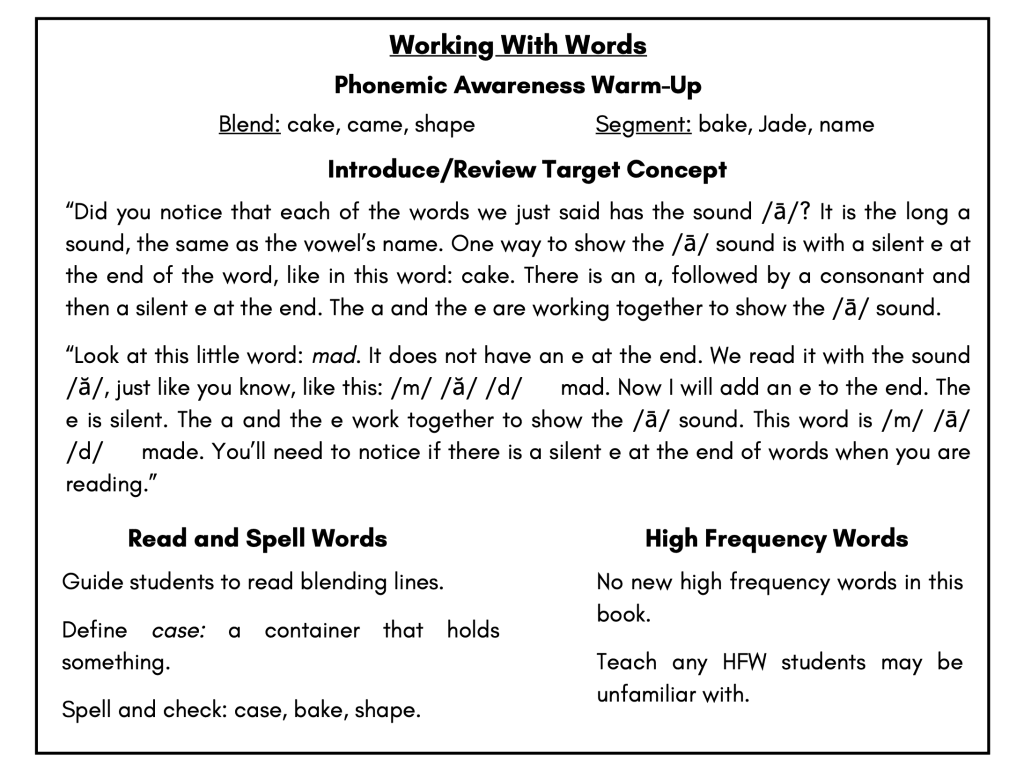
A lesson may start with a quick phonemic awareness warm-up, asking students to blend sounds together to say words and segment sounds to take apart words. We recommend that you use words with the lesson’s target sound spellings. For example, a lesson that will teach the a_e sound spelling for long a might begin with students blending and segmenting words like cake, bake, and name.
Then: Introduce or Review the Target Sound Spelling(s)
Here, you get to the core of the lesson, introducing or reviewing a target sound spelling. In this case, the a_e spelling for long a. Here’s a tip: Remember to use consistent language and images that support phonics keywords with students in whole group, small group, 1-1, and tutoring to avoid confusion! Consistent language and visuals can be a part of your toolkit. Our teacher guides provide example language, but we recommend you work with your own consistent language if you have a core phonics program.
Next: Practice Reading and Spelling Words
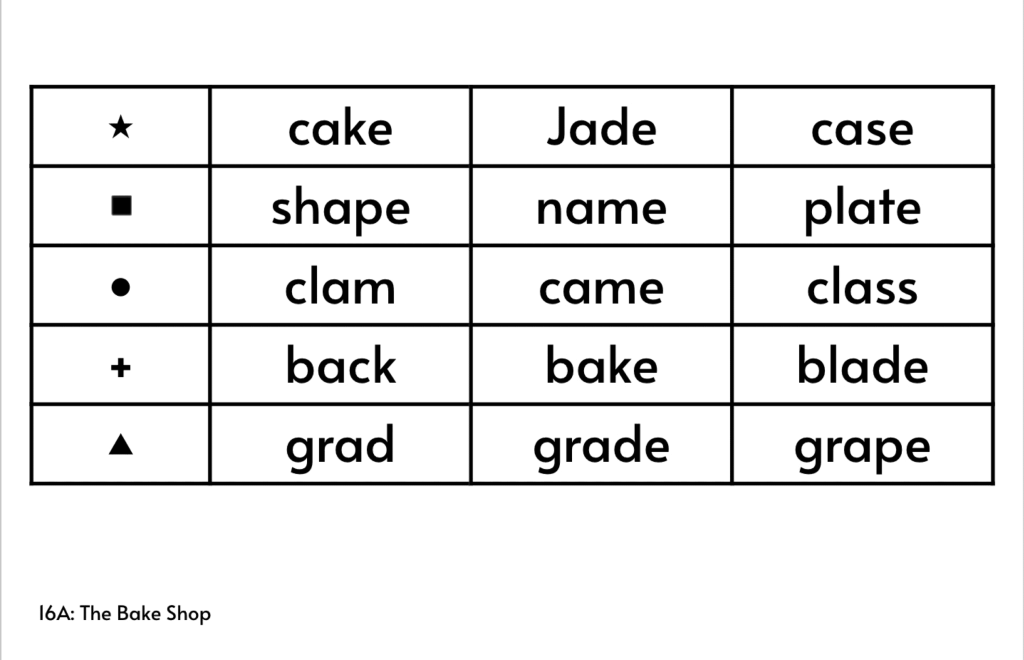
Now the sound-spelling(s) can be put into use in isolated practice. Many teachers like to use blending lines, a term likely coined by Wiley Blevins, in order to do so. The teacher can model, invite students to work along chorally, and then provide corrective feedback as students practice decoding with the target sounds. Many blending lines also include words for review. Students can practice spelling a few words as well.
Last: Read Connected Text
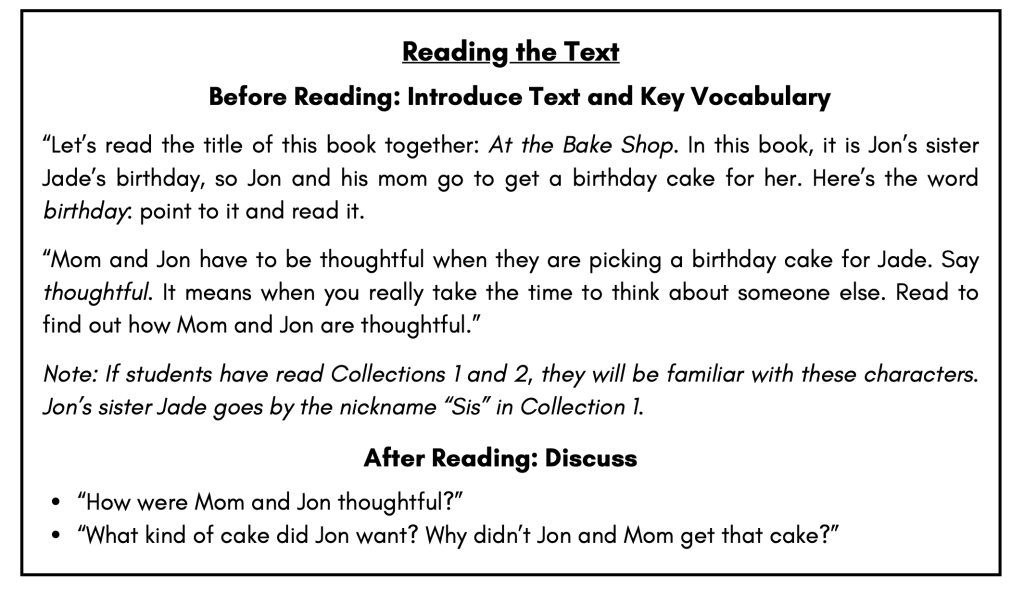
Now that students have practiced decoding in isolation, it’s time to put that decoding to good use. Using a carefully selected text, like a decodable one, can offer lots of targeted reading practice. Because reading is a meaning-making activity, introduce the text, focus on vocabulary, and set a purpose for reading. Then, get going! The text can be read in an echo reading, choral reading, partner reading, and/or independent reading model. Provide informative and corrective feedback as students read and work their decoding muscles.
After reading the text, take a moment to make meaning about the text. This can be with just a few simple questions about the plot or even encouraging students to use a new vocabulary word. Fun tidbit: our Bit by Bit Decodables are purposefully brief so students can read the text relatively quickly.
Here’s an example of before and after reading language that supports comprehension:
To close, offer the text to children for rereading or to take home. You’ve done it! With your own decoding toolkit in hand, this kind of lesson can take place in just 8-12 minutes.
Need resources?
Daffodil Hill Press Bit by Bit Decodables provide resources to do just that. Both the Classroom Sets and One of Each Sets come with decodable texts that unroll phonics sequentially and systematically, as well as online lesson plans and phonic decoding word lists (we call them blending lines for each book). Classroom Sets come with these resources printed and spiral bound as a Teacher Kit. Our Spanish collection, Los Narcisos, offers the same instructional support for decoding in original Spanish language decodable texts, too.
Explore all of the Daffodil Hill Press collections here.